
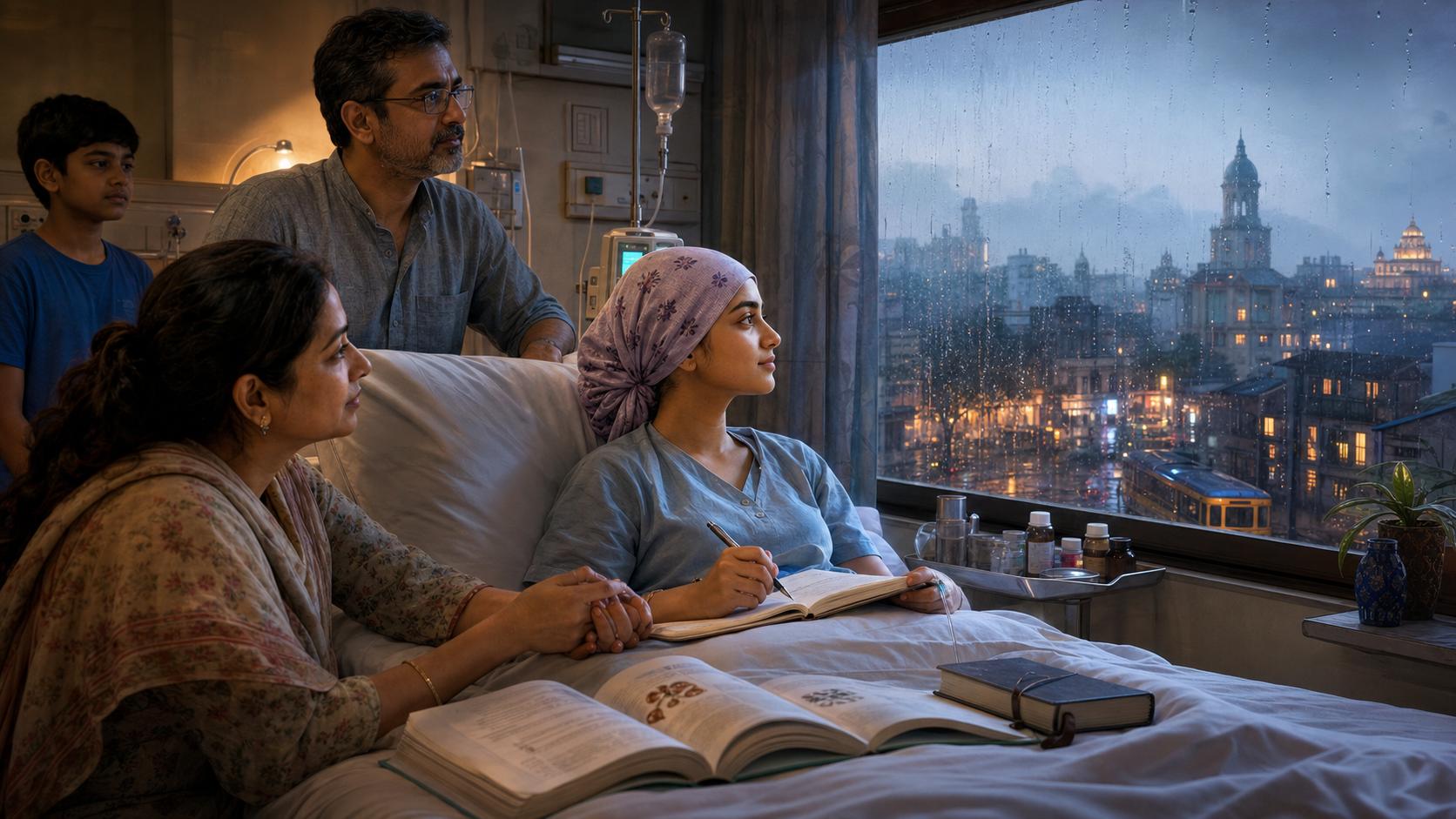
In the bustling heart of Central Kolkata, where the narrow lanes of Ripon Street hummed with the daily rhythm of life—vendors calling out fresh produce, the distant clang of tram bells from nearby Rafi Ahmed Kidwai Road, and the aroma of street-side ‘chai’ mingling with incense from old mosques—lived Avika Sen. At sixteen, she was a girl caught between the vibrant chaos of her neighbourhood and the quiet intensity of her own mind. Ripon Street, with its mix of colonial-era buildings, modest apartments, and a tight-knit community of families, was her world. The Sen family occupied a second-floor flat in a weathered four-story building, where the afternoon sun filtered through grilled windows, casting patterns on the worn marble floors.
Avika was exceptionally intelligent. Teachers at her ICSE-affiliated school in the vicinity often remarked on her sharp analytical skills, especially in biology and mathematics. She could dissect complex concepts with ease, sketching intricate diagrams of human anatomy during free periods or solving differential equations in her head while helping her mother with household chores. Yet, her studies were irregular. Not out of laziness, but because life pulled her in multiple directions. Her father, Mr. Rajesh Sen, worked long hours as a clerk in a government office near Esplanade, often returning exhausted. Her mother, Mrs. Meera Sen, managed a small tailoring business from home, stitching salwar suits and blouses for neighbourhood clients. Avika, the eldest of two, frequently stepped in to care for her younger brother, Arjun, aged ten, who was prone to asthma attacks triggered by the humid Kolkata air and pollution from the busy streets below.
The pressure of ICSE examinations loomed large. The Indian Certificate of Secondary Education curriculum demanded rigorous preparation—endless revisions of history dates, English literature essays, physics formulas, and detailed biology chapters on cell division and human physiology. Avika's friends, like her best friend Priya from the same building, burned the midnight oil with coaching classes in South Kolkata. Avika, however, juggled self-study with family responsibilities. She would study late into the night under the dim glow of a tube light, her notebooks filled with meticulous notes, but missed classes when Arjun fell ill or when her mother's sewing machine needed repairs. "I'll catch up," she would tell herself, her bright eyes reflecting determination amid the fatigue.
It started subtly in the humid months leading up to the exams. Avika began feeling unusually tired. What she dismissed as the strain of irregular sleep and the city's oppressive heat turned into persistent fatigue that no amount of rest could shake. She bruised easily—small knocks against furniture left purple marks on her fair skin that lingered for weeks. Frequent nosebleeds during study sessions left bloodstains on her textbooks, which she hid from her parents. "It's just the dry weather," she reasoned, wiping her nose and returning to her notes on mitosis and meiosis, ironically the very processes gone awry in her body.
One evening, as the call to prayer echoed from a nearby mosque and the street lights flickered on along Ripon Street, Avika collapsed while helping her mother fold clothes. The room spun, her limbs heavy as lead. "Ma, I feel so weak," she whispered before blacking out briefly. Panic set in. Rajesh rushed her to a local nursing home near Taltala, but the doctor there, after basic blood tests, referred them urgently to a larger facility.
The journey through Kolkata's medical landscape began at the iconic SSKM Hospital (Seth Sukhlal Karnani Memorial Hospital), formerly known as PG Hospital, one of the premier government institutions in the city handling complex cases. The outpatient department was a sea of humanity—patients from all corners of West Bengal waiting in long queues. After hours of tests, the haematologist, Dr. Anirban Mukherjee, a seasoned oncologist in his late forties with a kind yet grave demeanour, reviewed the reports.
"Avika's complete blood count shows severe abnormalities," Dr. Mukherjee explained to the anxious parents in a cramped consultation room. "Her haemoglobin is critically low at 6.5 g/dL, platelets are dangerously reduced at 20,000 per microliter, and the white blood cell count is elevated but with blasts—immature cells. This suggests acute leukaemia, likely involving the bone marrow."
Bone marrow cancer, in medical terms, often refers to malignancies like Acute Lymphoblastic Leukaemia (ALL) or Acute Myeloid Leukaemia (AML), where cancerous cells proliferate uncontrollably in the bone marrow, the spongy tissue inside bones responsible for producing blood cells. In adolescents like Avika, ALL is more common, accounting for a significant portion of childhood cancers. The disease arises from genetic mutations in lymphoid precursor cells, leading to the overcrowding of the marrow with lymphoblasts. These abnormal cells spill into the bloodstream, crowding out healthy red blood cells, platelets, and white blood cells.
Symptoms aligned perfectly: fatigue from anaemia (low red cells), easy bruising and bleeding from thrombocytopenia (low platelets), and increased infection risk from dysfunctional leukocytes. Further tests were ordered—bone marrow aspiration and biopsy from the posterior iliac crest, a painful procedure where a needle extracts marrow samples under local anaesthesia. Flow cytometry and cytogenetic analysis confirmed precursor B-cell ALL with Philadelphia chromosome negativity, a relatively favourable subtype but still aggressive.
The diagnosis hit like a thunderbolt. "Cancer? Bone marrow cancer?" Meera repeated, tears streaming as they sat in the hospital corridor, the weight of Ripon Street's everyday struggles now compounded by this invisible enemy. Avika, pale and hooked to an IV for supportive care, listened quietly. Her intelligence made it worse; she researched on her phone during brief lucid moments, understanding terms like "induction chemotherapy," "minimal residual disease," and "hematopoietic stem cell transplant."
Treatment began immediately. The induction phase aimed at achieving remission by eradicating leukemic cells. The regimen followed protocols like those from the Children's Oncology Group or Indian adaptations: vincristine, daunorubicin, prednisone, and asparaginase, administered via central venous catheter to avoid vein damage. Hospital stays stretched into weeks at the pediatric oncology ward. Avika's room overlooked the hospital grounds, where monsoon rains lashed the trees, mirroring the storm inside her.
The side effects were brutal. Chemotherapy targeted rapidly dividing cells, affecting not just cancer but hair follicles, the gastrointestinal lining, and the immune system. Avika's long, dark hair fell out in clumps, leaving her bald and self-conscious. "I look like a ghost," she told Priya during a visit, forcing a smile. Nausea and vomiting were constant; antiemetics like ondansetron helped marginally. Mucositis made eating painful—her throat and mouth ulcerated, forcing liquid nutrition. Neutropenia led to fever spikes and infections; she battled a severe bacterial sepsis that required broad-spectrum antibiotics and isolation.
Despite the pain, Avika's mind remained sharp. In rare pain-free hours, she read her ICSE biology textbook, annotating chapters on the immune system with newfound, painful insight. "The marrow is my battlefield now," she wrote in her journal. Her irregularity in studies before seemed trivial; now, the exams felt like a distant dream. The school board granted her special considerations, but Avika worried about falling behind her peers.
Family life transformed. Rajesh took leave, his savings depleting rapidly on medicines not fully covered by government schemes. Meera shuttled between home and hospital, managing Arjun's school and her tailoring. Neighbours on Ripon Street rallied—Mrs. Khan from downstairs brought home-cooked khichdi, while Priya organized a small fundraiser among classmates. Yet, the emotional toll was immense. Avika suffered silently, her intelligence amplifying every fear. She researched survival rates: for adolescent ALL, five-year survival hovers around 70-80% with modern protocols, but relapses and complications like graft-versus-host disease in transplants added uncertainty.
Consolidation therapy followed, involving high-dose methotrexate and cytarabine to prevent central nervous system involvement, common in ALL. Intrathecal chemotherapy—direct injection into the spinal fluid—was agonizing, causing headaches and back pain. Avika endured lumbar punctures with stoic resolve, biting her lip until it bled.
A turning point came during a consolidation cycle. Her counts dropped critically, leading to a haemorrhagic episode. Blood transfusions became routine—packed red cells for anaemia, platelets for bleeding risks. Dr. Mukherjee discussed allogeneic bone marrow transplant as a potential curative option if a matched donor was found. HLA typing of family members showed Arjun as a partial match, but a full sibling match was rare. Searches through Indian bone marrow registries like DATRI yielded no immediate match.
The suffering intensified. Graft preparation involved total body irradiation in some protocols, but for Avika, they opted for chemotherapy-based conditioning. Isolation in a HEPA-filtered room for weeks felt like solitary confinement. Infections loomed; fungal pneumonia nearly claimed her. Pain from mucositis required morphine drips. "Why me?" she cried one night to her mother, the first crack in her facade. Her body, once agile enough to navigate Ripon Street's crowded alleys on her cycle for tuitions, now betrayed her with every breath.
Psychological support came from the hospital's counsellor, Dr. Sonia Roy, who helped Avika process the trauma. "Your mind is your greatest strength, Avika. Use it to fight." Avika channeled her intelligence into understanding her disease—learning about tyrosine kinase inhibitors if needed, or CAR-T cell therapy on the horizon for relapsed cases. Modern medical science offered glimmers: targeted therapies, improved supportive care with growth factors like G-CSF to boost neutrophil recovery, and better antifungal prophylactics.
Months blurred into a cycle of hope and despair. Remission was achieved after induction, confirmed by bone marrow showing less than 5% blasts. Maintenance therapy with mercaptopurine and methotrexate stretched over two years, requiring frequent hospital visits. During this time, Avika resumed limited studies from home, her laptop screen a portal to virtual classes. She missed the ICSE exams that year but prepared for the next, her notes now interspersed with medical diagrams of hematopoiesis.
A crisis hit during maintenance: a relapse detected by rising minimal residual disease via PCR testing. Back to intensive re-induction. The family faced the possibility of transplant. Miraculously, a matched unrelated donor was located through international registries—a young adult from Europe, coordinated via global networks. The transplant process was a medical marvel and ordeal. The conditioning regimen wiped out her marrow completely: high-dose chemo and radiation. Then, the infusion of donor stem cells—a simple IV drip carrying hope. Engraftment took weeks, monitored by chimerism studies showing donor cells taking root.
Post-transplant complications tested her limits. Acute graft-versus-host disease (GVHD) affected her skin and gut, causing rashes and diarrhea. Immunosuppressants like cyclosporine managed it but increased infection risks. Chronic GVHD later required long-term steroids, leading to weight gain, moon face, and osteoporosis risks—ironic for a bone marrow warrior.
Through it all, Avika's spirit endured. In the quiet of her hospital bed, overlooking the Kolkata skyline from a private room they eventually afforded, she reflected on life. Ripon Street awaited—its vibrant community, the festivals like Durga Puja she missed, the simple joys of street food she could no longer enjoy freely due to dietary restrictions. Her intelligence, once scattered by irregularity, now focused laser-like on recovery and studies. She topped her delayed exams upon returning, her essays on resilience drawing from personal hell.
Friends and family evolved too. Priya became a steadfast companion, sharing notes and laughter. Arjun, inspired, took better care of his health. Rajesh and Meera found strength in unity, their bond deepened by shared vigils.
Years later, at eighteen, Avika stood on the threshold of adulthood. Cancer-free, with regular follow-ups monitoring for late effects like secondary cancers, cardiac toxicity from anthracyclines, or endocrine issues, she pursued higher studies in biomedical sciences. Her story became one of quiet triumph. In the lanes of Ripon Street, where life pulsed on, Avika's journey symbolized the intersection of human fragility and medical progress.
Modern oncology had transformed her fate—from a death sentence decades ago to a manageable chronic condition with cures in many cases. Bone marrow transplants, once experimental, were now standard, with success rates improving through better matching, reduced-intensity conditioning, and post-transplant cyclophosphamide for haploidentical donors.
Avika's suffering was profound—physical agony, emotional isolation, the loss of teenage normalcy. Yet, it forged her into someone wiser. She volunteered at cancer support groups, sharing her knowledge of treatments, advocating for early detection. "Irregular studies almost cost me everything," she would say in talks, "but the fight taught me discipline."
In the end, the girl from Ripon Street, with her brilliant mind and scarred body, embodied hope. The bone marrow that once betrayed her now produced healthy blood, a testament to science, resilience, and the unyielding human spirit amid Kolkata's enduring chaos.
Join the Discussion
Ritwik Thakur
2 weeks agoAvika is a role model of indomitable spirit. The story truly depicts that theme. Well written, my friend!
Babla Munshi
2 weeks agoThank you 👍
Prithwiraj Pal
2 weeks ago👍👍
SRABANTI ROY
3 weeks agoThis emotional story touched my heart deeply. The characters felt real , and the ending inspired me in many ways!👌🌷
Babla Munshi
2 weeks ago@SRABANTI ROY Thank you Ma'm for your kind perusal of my write-up...